
Here’s a question I’m getting from nearly every team I coach right now:
“Should we be using AI in our sprints?”
My answer is the same as it’s always been when a shiny new tool shows up at the standup: it depends on whether your fundamentals are solid. A hammer doesn’t fix a crooked foundation. And AI won’t fix a broken backlog.
That said — 2026 is genuinely different. AI has crossed a line this year from “assistant that autocompletes your sentences” to something closer to a junior team member that can analyze sprint data, flag risks before they become blockers, and help your Product Owner prioritize with actual data instead of gut instinct. That’s worth paying attention to.
Let me break down what’s real, what’s hype, and what your team should actually be doing about it.
What AI Is Actually Doing for Agile Teams Right Now
The honest answer is: a lot of administrative busywork — and that’s not a small thing.
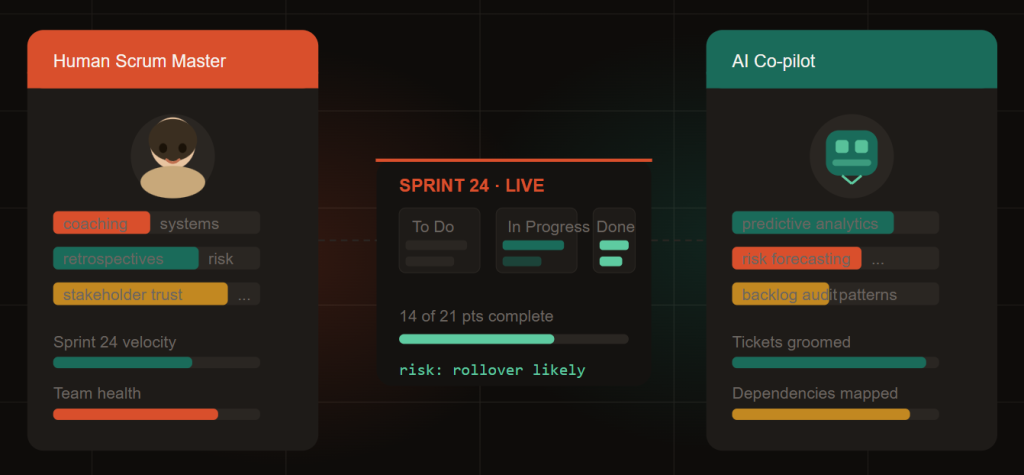
Think about how much of a Scrum Master’s week disappears into status updates, Jira ticket grooming, sprint reports, and chasing down blockers. AI tools integrated into platforms like Jira are starting to automate that layer. Predictive analytics can flag when a sprint is trending toward rollover before Friday’s review. Backlog analysis can surface tickets that haven’t been touched in 90 days or that have missing acceptance criteria.
This is genuinely useful. Not because it replaces judgment — but because it gives your team more time for the judgment calls that actually matter.
The Part Nobody Talks About: 95% of AI Projects Are Still Failing
Here’s the statistic that should stop any team from jumping headfirst into AI tooling without a plan.
Despite all the momentum, the failure rate for generative AI projects that sit on top of broken organizational processes remains stubbornly high. The reason? It’s not the algorithm. It’s the people and the process.
This is exactly what we’ve been saying at AgileOmatic since 2015. Agile maturity isn’t about the tools you use — it’s about the discipline underneath them. If your team can’t write a clear user story, AI isn’t going to write it for you. If your retrospectives don’t produce actionable outcomes, AI-generated sprint summaries won’t change that culture.
The teams that are getting real ROI from AI in 2026 are the ones that already had their agile house in order. They’re using AI to accelerate what was already working — not to paper over what wasn’t.
Three Things to Do Before You Add AI to Your Workflow
1. Run an honest maturity check. Before you add any AI layer, ask yourself: how does your team score on the 22 agile practices we track in our Agile Automation Checkpoint Matrix? If you’re below the “Scrum Practitioner” level on more than a third of them, fix those first. AI will amplify your team’s habits — good and bad.
2. Redefine what your Scrum Master does. The role is evolving fast. The best Scrum Masters in 2026 aren’t ceremony facilitators — they’re organizational coaches who understand both human dynamics and AI capabilities. If your SM is spending most of their week in Jira updating tickets, something is already off. AI should handle that layer; your SM should be focused on removing structural blockers and developing the team.
3. Let your Product Owner use AI for discovery, not just documentation. This is the highest-leverage use case we’re seeing. POs who are using AI to analyze user behavior patterns, cluster feedback, and stress-test roadmap priorities are making faster, better decisions. The POEM framework (Product Ownership Execution Model) we introduced in 2020 maps the full product lifecycle — and AI slots in beautifully at the discovery and prioritization stages when the underlying model is already in place.
What This Doesn’t Change
The Agile Manifesto turned 25 this year. And here’s what’s remarkable: every one of its four core values still holds.
Individuals and interactions over processes and tools. An AI can generate a sprint report. It cannot read the room in a retrospective. It cannot sense when your lead developer is burning out. It cannot build the trust that makes a team willing to raise a red flag before a sprint collapses.
AI is a powerful new tool in the agile toolkit. But the toolkit has always existed to serve the humans using it — not the other way around.
The teams that will win in the next few years aren’t the ones who adopted AI the fastest. They’ll be the ones who kept the fundamentals sharp while thoughtfully layering in the new capabilities.
That’s been the AgileOmatic philosophy since day one. And in 2026, it’s more relevant than ever.
Want to know where your team stands before adding AI to the mix?
Get in touch and ask us about the Agile Automation Checkpoint Matrix — our 22-point maturity assessment designed to tell you exactly where to focus first.
Tags: Agile, AI, Scrum, Product Ownership, Jira, Agile Coaching, 2026 Trends